

This website uses cookies
We use cookies to personalise content and ads, to provide social media features and to analyse our traffic. We also share information about your use of our site with our social media, advertising and analytics partners who may combine it with other information that you’ve provided to them or that they’ve collected from your use of their services.
Consent Selection
Details
  • Necessary cookies help make a website usable by enabling basic functions like page navigation and access to secure areas of the website. The website cannot function properly without these cookies.
    • Learn more about this provideropens in a new window

      Some of the data collected by this provider is for the purposes of personalization and measuring advertising effectiveness. The provider may use the IP Addresses for ads measurement and ads personalization.

      test_cookieUsed to check if the user's browser supports cookies.
      Maximum Storage Duration: 1 dayType: HTTP Cookie
    • Learn more about this provideropens in a new window
      cookietestThis cookie is used to determine if the visitor has accepted the cookie consent box.
      Maximum Storage Duration: SessionType: HTTP Cookie
    • Learn more about this provideropens in a new window
      bcookieUsed in order to detect spam and improve the website's security.
      Maximum Storage Duration: 1 yearType: HTTP Cookie
      li_gcStores the user's cookie consent state for the current domain
      Maximum Storage Duration: 180 daysType: HTTP Cookie
    • _cfuvidThis cookie is a part of the services provided by Cloudflare - Including load-balancing, deliverance of website content and serving DNS connection for website operators.
      Maximum Storage Duration: SessionType: HTTP Cookie
      CookieConsentStores the user's cookie consent state for the current domain
      Maximum Storage Duration: 1 yearType: HTTP Cookie
    • __cf_bm [x18]This cookie is used to distinguish between humans and bots. This is beneficial for the website, in order to make valid reports on the use of their website.
      Maximum Storage Duration: 1 dayType: HTTP Cookie
  • Preference cookies enable a website to remember information that changes the way the website behaves or looks, like your preferred language or the region that you are in.
    • Learn more about this provideropens in a new window
      lidcRegisters which server-cluster is serving the visitor. This is used in context with load balancing, in order to optimize user experience.
      Maximum Storage Duration: 1 dayType: HTTP Cookie
  • Statistic cookies help website owners to understand how visitors interact with websites by collecting and reporting information anonymously.
    • Learn more about this provideropens in a new window
      __hsscIdentifies if the cookie data needs to be updated in the visitor's browser.
      Maximum Storage Duration: 1 dayType: HTTP Cookie
      __hssrcUsed to recognise the visitor's browser upon reentry on the website.
      Maximum Storage Duration: SessionType: HTTP Cookie
      __hstcSets a unique ID for the session. This allows the website to obtain data on visitor behaviour for statistical purposes.
      Maximum Storage Duration: 180 daysType: HTTP Cookie
      hubspotutkSets a unique ID for the session. This allows the website to obtain data on visitor behaviour for statistical purposes.
      Maximum Storage Duration: 180 daysType: HTTP Cookie
    • hs-cta-interactions#ctaCollects statistics on the visitor's visits to the website, such as the number of visits, average time spent on the website and what pages have been read.
      Maximum Storage Duration: PersistentType: IndexedDB
  • Marketing cookies are used to track visitors across websites. The intention is to display ads that are relevant and engaging for the individual user and thereby more valuable for publishers and third party advertisers.
    • Learn more about this provideropens in a new window
      _fbpUsed by Facebook to deliver a series of advertisement products such as real time bidding from third party advertisers.
      Maximum Storage Duration: 3 monthsType: HTTP Cookie
      lastExternalReferrerDetects how the user reached the website by registering their last URL-address.
      Maximum Storage Duration: PersistentType: HTML Local Storage
      lastExternalReferrerTimeDetects how the user reached the website by registering their last URL-address.
      Maximum Storage Duration: PersistentType: HTML Local Storage
    • Learn more about this provideropens in a new window

      Some of the data collected by this provider is for the purposes of personalization and measuring advertising effectiveness. The provider may use the IP Addresses for ads measurement and ads personalization.

      _gcl_auUsed to measure the efficiency of the website’s advertisement efforts, by collecting data on the conversion rate of the website’s ads across multiple websites.
      Maximum Storage Duration: 3 monthsType: HTTP Cookie
    • Learn more about this provideropens in a new window
      pagead/1p-user-list/#Tracks if the user has shown interest in specific products or events across multiple websites and detects how the user navigates between sites. This is used for measurement of advertisement efforts and facilitates payment of referral-fees between websites.
      Maximum Storage Duration: SessionType: Pixel Tracker
      __hmpl [x2]Collects information on user preferences and/or interaction with web-campaign content - This is used on CRM-campaign-platform used by website owners for promoting events or products.
      Maximum Storage Duration: PersistentType: HTML Local Storage
      __ptq.gifSends data to the marketing platform Hubspot about the visitor's device and behaviour. Tracks the visitor across devices and marketing channels.
      Maximum Storage Duration: SessionType: Pixel Tracker
      HUBLYTICS_EVENTS_53 [x2]Collects data on visitor behaviour from multiple websites, in order to present more relevant advertisement - This also allows the website to limit the number of times that they are shown the same advertisement.
      Maximum Storage Duration: PersistentType: HTML Local Storage
      outpost/video-embed/error.gifPending
      Maximum Storage Duration: SessionType: Pixel Tracker
      viral-links/v1/trackingTracks the individual sessions on the website, allowing the website to compile statistical data from multiple visits. This data can also be used to create leads for marketing purposes.
      Maximum Storage Duration: SessionType: Pixel Tracker
      _gcl_lsTracks the conversion rate between the user and the advertisement banners on the website - This serves to optimise the relevance of the advertisements on the website.
      Maximum Storage Duration: PersistentType: HTML Local Storage
  • Unclassified cookies are cookies that we are in the process of classifying, together with the providers of individual cookies.
Cookie declaration last updated on 10/9/26 by Cookiebot
[#IABV2_TITLE#]
[#IABV2_BODY_INTRO#]
[#IABV2_BODY_LEGITIMATE_INTEREST_INTRO#]
[#IABV2_BODY_PREFERENCE_INTRO#]
[#IABV2_BODY_PURPOSES_INTRO#]
[#IABV2_BODY_PURPOSES#]
[#IABV2_BODY_FEATURES_INTRO#]
[#IABV2_BODY_FEATURES#]
[#IABV2_BODY_PARTNERS_INTRO#]
[#IABV2_BODY_PARTNERS#]
About
Cookies are small text files that can be used by websites to make a user's experience more efficient.

The law states that we can store cookies on your device if they are strictly necessary for the operation of this site. For all other types of cookies we need your permission.

This site uses different types of cookies. Some cookies are placed by third party services that appear on our pages.

You can at any time change or withdraw your consent from the Cookie Declaration on our website.

Learn more about who we are, how you can contact us and how we process personal data in our Privacy Policy.

Please state your consent ID and date when you contact us regarding your consent.

Summary

Market development funds best practices come down to one idea: make the fund easy to find, easy to apply for and easy to turn into a campaign. Most MDF budgets are not lost to bad strategy; they go unused because partners hit friction at the application, approval or activation stage. The guide sets out eight practices B2B software vendors can apply to their partner programs, why funds go unused, and what changes for programs that run across APAC.

Key Facts

  • Market development funds best practices come down to one idea: make the fund easy to find, easy to apply for and easy to turn into a campaign.
  • Most MDF budgets are not lost to bad strategy; they go unused because partners hit friction at the application, approval or activation stage.
  • Market development funds, also called marketing development funds, are money a vendor gives partners to pay for approved marketing activity.
  • Co-op funds typically accrue as a share of a partner's sales and partners claim them back, while vendors usually allocate MDF against a plan or application.
  • Pre-approved templates are described as the biggest single lever on activation.
  • Unused MDF is usually a process problem rather than a partner problem.
  • Programs that span APAC add a layer of complexity because partners sit in different markets, languages and time zones.
  • Three APAC adjustments help: localise templates and guidance, agree approval ownership by market, and set expectations on currency, tax and claim documentation early.

Frequently Asked Questions

What are market development funds?

Market development funds (MDF), also called marketing development funds, are money a vendor gives partners to pay for approved marketing activity.

What is the difference between MDF and co-op funds?

Co-op funds typically accrue as a share of a partner's sales and partners claim them back, while vendors usually allocate MDF against a plan or application.

Why do market development funds go unused?

Unused MDF is usually a process problem rather than a partner problem.

How do you measure MDF success?

Track fund utilisation, time to approval, partner activation, claim turnaround, campaign quality and the pipeline linked to funded activity.

What adjustments help MDF programs across APAC?

Localise templates and guidance, agree approval ownership by market, and set expectations on currency, tax and claim documentation early.

Related Entities

Companies
Archetype, Wikipedia, TechTarget, HubSpot, LinkedIn, Google, Meta Platforms, Inc., Cookiebot, Cloudflare
Locations
Australia, China, Hong Kong, India, Malaysia, Singapore
Technologies
MDF, co-op funds

Market development funds best practices for B2B software partner programs

Market development funds best practices come down to one idea: make the fund easy to find, easy to apply for and easy to turn into a campaign. Most MDF budgets are not lost to bad strategy. They go unused because partners hit friction at the application, approval or activation stage.

This guide sets out eight practices B2B software vendors can apply to their partner programs, why funds go unused, and what changes for programs that run across APAC. If you want the full picture of how a program is run, start with our guide to MDF program management.

What are market development funds?

Market development funds (MDF), also called marketing development funds, are money a vendor gives partners to pay for approved marketing activity. For example, partners typically use them for campaigns, events, content and lead generation that grow demand for the vendor’s products. See Wikipedia on market development funds or TechTarget’s definition of MDF for the basics.

Co-op funds are a close relative. They typically accrue as a share of a partner’s sales and partners claim them back, while vendors usually allocate MDF against a plan or application. Terms differ by vendor, so always check the rules of the program in front of you.

Market development funds best practices for B2B software vendors
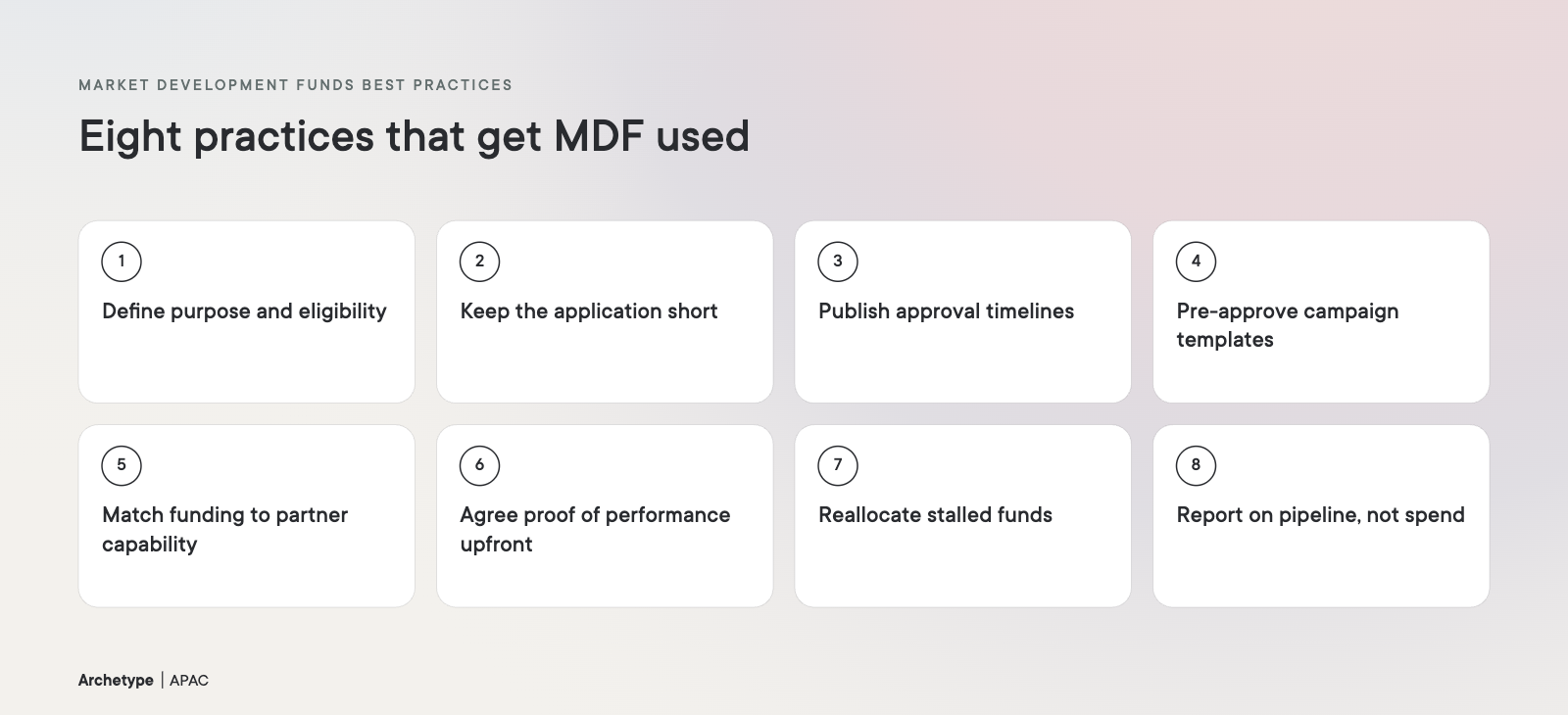
Market development funds best practices: eight steps for B2B software partner programs

1. Define the purpose and eligibility

Start with what the fund is for. Name the goals it supports, such as pipeline, product launches or new-market entry, and list which partners and activities qualify. As a result, clear rules mean fewer rejected applications and fewer questions to your team.

2. Keep the application short

A long form is the quickest way to lose a busy partner. Ask only for what you need to decide: the activity, audience, budget, timing and expected outcome. Provide a worked example of an approved request so partners know what good looks like.

3. Publish approval timelines

Partners plan campaigns around dates. If approval takes an unknown number of weeks, they stop applying. Instead, set a review window, name who owns the decision and tell partners when they will hear back.

4. Pre-approve campaign templates

Pre-approved templates are the biggest single lever on activation. Give partners ready-to-use email, social, landing page and event assets that are already on brand, so a funded campaign can launch without a creative brief. Our MDF activation support covers this stage, and our B2B and SaaS copywriting team writes the copy.

5. Match funding to partner capability

However, not every partner can run a campaign alone. Some need a toolkit, others need hands-on help. Segment partners by capability and offer the right level of support, rather than the same process for everyone.

6. Agree proof of performance upfront

Claims stall when nobody agreed what evidence was needed. Set the requirements at approval: screenshots, lead lists, attendance data or campaign reports. Partners then know what to collect, and your team can process claims faster.

7. Reallocate stalled funds

Set a deadline for activating approved funds and a rule for what happens afterwards. Moving unused budget to partners who are ready to launch keeps money working and signals that the program expects action.

8. Report on pipeline, not just spend

Spend tells you partners are drawing on the fund. However, it does not tell you whether it works. Track fund utilisation, time to approval, partner activation and the leads or pipeline linked to funded activity, then use the results to adjust next quarter’s rules.

Why market development funds go unused

Unused MDF is usually a process problem rather than a partner problem. The table below maps the common symptoms to their likely cause and a practical fix.

What you seeLikely causeFix
Partners ask what MDF is availableThe program is hard to find or poorly explainedPublish one clear program page and a partner-facing guide
Applications arrive incompleteThe form is long or the rules are vagueShorten the form and add examples of approved activity
Approvals take weeksNo owner or service level for decisionsSet a fixed review window and name an owner
Funds are approved but campaigns never launchPartners lack assets, time or skillsPre-approve templates and offer creative support
Claims are rejected or delayedProof of performance was unclear at approvalAgree claim requirements before the activity starts
Budget sits unused at quarter endNo deadline or reallocation ruleAdd use-it-or-lose-it dates and move stalled funds to active partners

MDF best practices for APAC partner programs

Programs that span APAC add a layer of complexity, because partners sit in different markets, languages and time zones, and a process built for one region rarely fits another without changes.

In practice, three adjustments help. Localise templates and guidance so partners can use them without rewriting. Agree approval ownership by market, so decisions do not queue behind a single global team. And set expectations on currency, tax and claim documentation early, because they differ by country. Our APAC teams help global software brands adapt programs for local partners.

When to bring in outside support

Outside support makes sense when your internal team is stretched, when partners are not activating or when you are launching or restructuring a program. We offer MDF support for B2B software partners, broader partner marketing and full MDF program management, from light-touch administration to end-to-end delivery.

Market development funds best practices FAQs

What are market development funds best practices?

They are the habits that help partners use MDF: clear eligibility, a short application, fast approvals, pre-approved campaign templates, agreed proof of performance, deadlines for activation and reporting on pipeline rather than spend.

What does MDF stand for in marketing?

MDF stands for marketing development funds, also known as market development funds. A vendor provides them to partners to run approved marketing activity.

What is the difference between MDF and co-op funds?

Co-op funds typically accrue as a percentage of a partner’s sales, and partners claim them back. Vendors usually allocate MDF against a plan or application. Rules vary by vendor, so check the terms of each program.

Why do MDF funds go unused?

Usually because of friction. Partners do not know the funds exist, the application is slow or unclear, they lack campaign assets, or nobody set a deadline to use the money.

How do you increase MDF utilisation?

Remove friction at each stage. Simplify the application, publish approval timelines, provide pre-approved templates, follow up on approved but stalled partners and reallocate funds that are not being used.

How do you measure MDF success?

Track fund utilisation, time to approval, partner activation, claim turnaround, campaign quality and the pipeline linked to funded activity.

Turn market development funds into campaigns that launch

If your MDF program needs more structure, faster activation or extra capacity, Archetype can help. In short, we can manage the admin, support the creative and guide partners from approval to launch.

Speak to Archetype about MDF program management

Contact Us